 Forge
by Michael Howe
Forge
by Michael Howe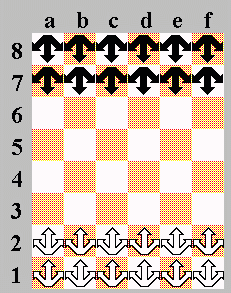

Forge
by Michael Howe
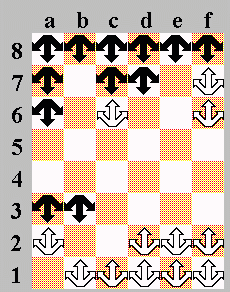
Forge is an abstract game for two players, played on a 6x8 board (smaller boards can also be used). Each player has 12 pieces, which move in a straight line, orthogonally or diagonally forward, as many squares as possible until blocked by a piece of either color or the edge of the board. For example, White's piece at b2, moving up the board, can move to b6 (blocked by Black's piece at b7), a3 (blocked by the board edge), or f6 (blocked by the board edge). White moves first and can move any man which is not blocked. Thereafter, each player can only move a piece which is adjacent (orthogonally or diagonally) to the square where the opponent's previous move stopped. If there are no pieces adjacent to the opponent's landing square, or all of the adjacent pieces are blocked, the player may move any unblocked piece. In the diagram above right, White has just moved a1f6, so Black can move any piece. If Black moves d7d3, White can move the piece at d2 (to a5 or f4) or e2 (to e7 or f3). If Black moves d8e7, White may move any piece, since the pieces at both f6 and f7 are blocked. The last player able to move wins.
A Windows version of Forge is available, including a help file, a computer opponent, and facilities for printing and saving games. The program costs $10, and can be sent by regular mail on a 3-1/2" diskette or CD-ROM (add $1 for postage and disk), or by e-mail in a .ZIP file (no extra charge). Payment is possible by Paypal (Michael Keller), or by check (U.S. funds, drawn on U.S. bank) or money order (send to Michael Keller, 1227 Lorene Drive, Pasadena, MD 21122, USA).
This article is copyright ©2005 by Michael Keller. All rights reserved.