Beeswax and Beehive --
Building in Ranks
There are only a handful of solitaires in which cards are packed on the
tableau by rank. In a couple of these, packing by
rank is only a means to an end. David Parlett's ingenious Curds and
Whey is essentially a one-deck relative of Spider; it allows
packing on the
tableau in rank, and also downward in suit; the object being to form
four complete suites
(sequences running from king down to ace in suit). Steve
Meretzky's Barbershop Quintet uses
packing by rank to facilitate discarding in sequence as in
Golf. In the
two games we describe in this article, cards are packed on the tableau
in rank only, the object being to form thirteen sets of four.
Beeswax and Beehive are both available in Solitaire
Virtuoso.
Beeswax is the name I am now
using for an excellent open
solitaire I have never seen in a book, though there are a fair number
of computer versions.
Among
the computer versions still available are Maurice Abraham's Patience Pack
(where it is called Pile Sort), a freeware package of 120 games and
puzzles first published in 1994 (the current version 8.0, written in
2005, still runs under Windows 7). The Linux solitaire collection
AisleRiot
implements it as Pileon. Pretty
Good Solitaire calls the game
Fifteen
Puzzle: not a particularly good name, as this solitaire is unrelated to
the
well-known sliding block puzzle popularized by Sam Loyd (fifteen
numbered pieces in a 4x4
grid, which have to
be arranged in order by sliding blocks into the one space in the grid).
In Beeswax, the
entire deck is dealt out in a tableau of 13 columns of 4 cards each,
with two empty
columns. It is usually
presented as thirteen fans of four cards each, with two empty spaces,
the fans and spaces
being arranged in a 3x5 or 4x4 array. I am not a fan of
fans: I prefer to have 15 parallel
columns, so that it is easy to see which columns have room left. In
Beeswax a
card may
only be moved onto a card of the same rank, or into an empty
column.
Each column can hold a maximum of four cards, so the
first play must be to one of the two empty columns. The
object is to form thirteen quartets of the same rank; completed
quartets are not discarded. Suits do not matter.
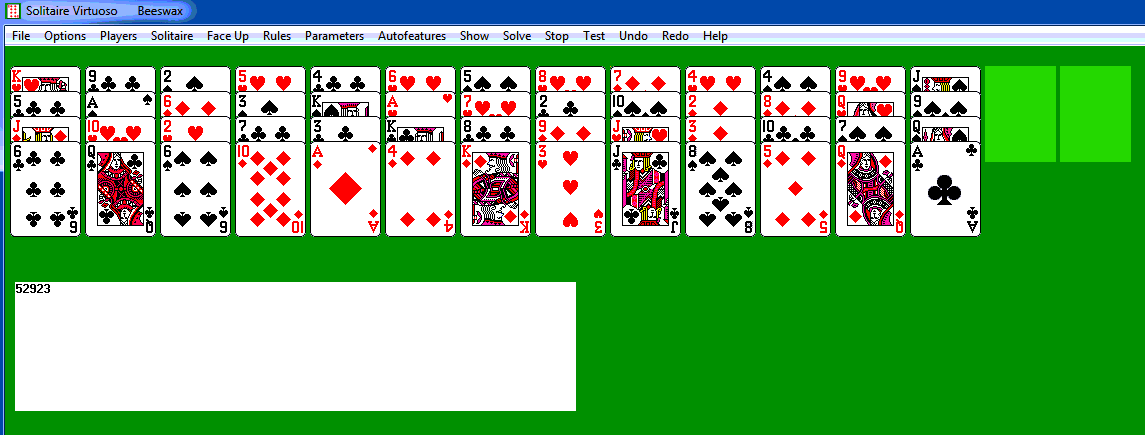
Let's play through a deal, number 52923, from Solitaire Virtuoso. Usually
the player wants to move, if possible, three (or even on occasion four)
cards of the
same rank to one of the two empty columns, trying to keep one column
empty as much as possible. Often there are no ranks with three
available cards, so we try to find a pair which will expose two more
playable cards. In this case moving the two aces to the first
empty column will uncover a queen and a three, both of which can be
played on. The moves are notated, as in other column-packing
games, using a hexadecimal extension of the standard FreeCell
notation. The
columns are numbered 1-9 and A-F, and each move is specified by giving
the starting and ending columns. So moving the ace of diamonds to
the first empty column is denoted 5E (this can be done
quickly by right-clicking the
AD, as in many Virtuoso games).
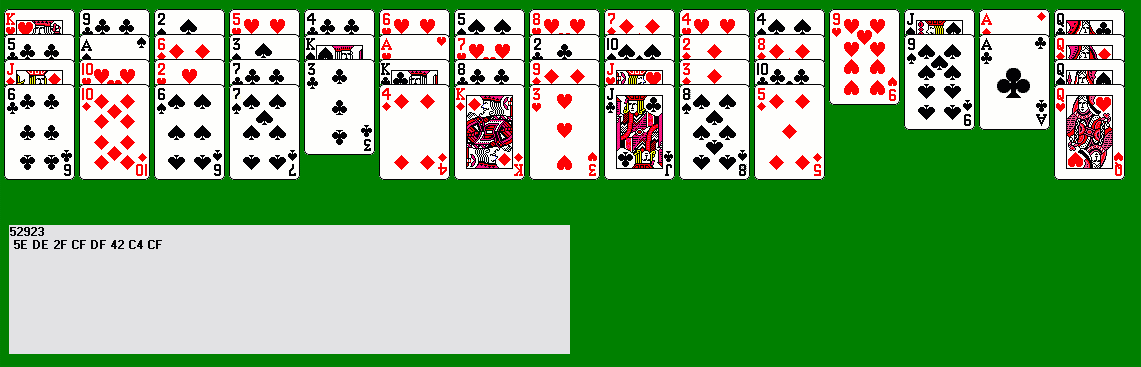
Moving the ace of clubs onto the ace of diamonds is DE. We now have three queens
free, and we can see that the fourth is in
column C; if we can find places to put the seven of spades and nine of
diamonds, we can get the four queens together. We move all
three queens into the last empty column, put the ten of diamonds on the
ten of hearts, and complete a quartet by putting the queen of hearts on
the
other three queens. Note the automatic recording of the solution.
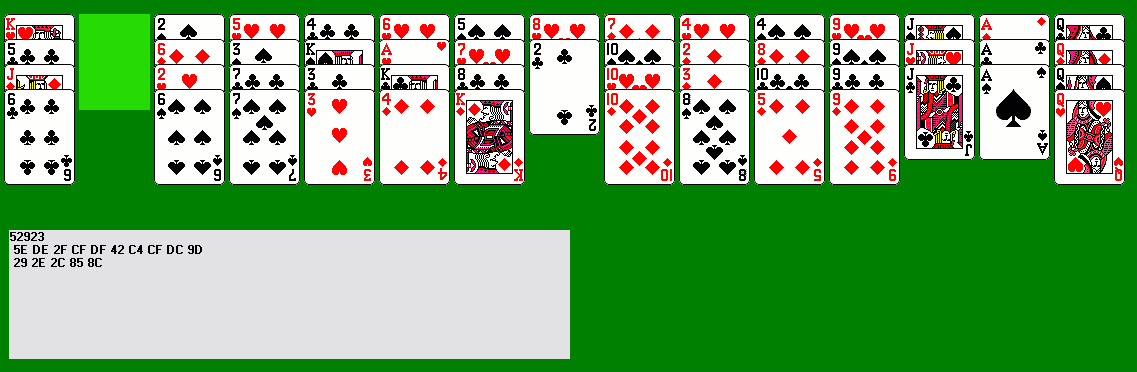
Now we could regain a space by putting the nine of hearts on the nine
of spades, but we can also clear column 2 if we can find a place for
the two tens. We can put them in column 9 if we can move the two
jacks, so we put the nine of spades onto the nine of hearts, move the
two jacks onto the jack of spades, the two tens onto the ten of spades,
and the ace of spades and nine of clubs onto their respective
columns. Now we have an empty column again, and four clean columns (columns with cards
all of the same rank). We can also move the
three of hearts onto the three of clubs and complete the quartet of
nines with the nine of diamonds. Sequences of plays like this are
not hard to visualize with practice.
We can now clear column 3 by putting the sixes in column 2 and the twos
in column 8; look for opportunities to clear columns with only two
ranks in them whenever possible. We also move the six of
clubs and jack of diamonds onto their corresponding columns. You
should always move free cards into clean
columns
(columns containing only one rank) whenever possible,
unless you have no empty columns and can create one by moving all of
the cards from a clean column onto another column. We also move
the
five of diamonds onto the five of clubs, uncovering the ten of clubs
and setting up another set of maneuvers. If we move all four tens
into the empty column 3, and the eight of spades into the eight of
diamonds, we can clear column 4 by putting the two sevens onto the
seven of diamonds, the three of spades on the three of diamonds, and
the five of hearts on the five of diamonds. But instead of moving
the five of hearts, we put the two fives from column 1 onto it, and we
can instead clear column 7 by moving each of the four cards onto a
different column (I call this a fountain,
and try to finish a deal with a fountain when I can). We're
almost finished now:
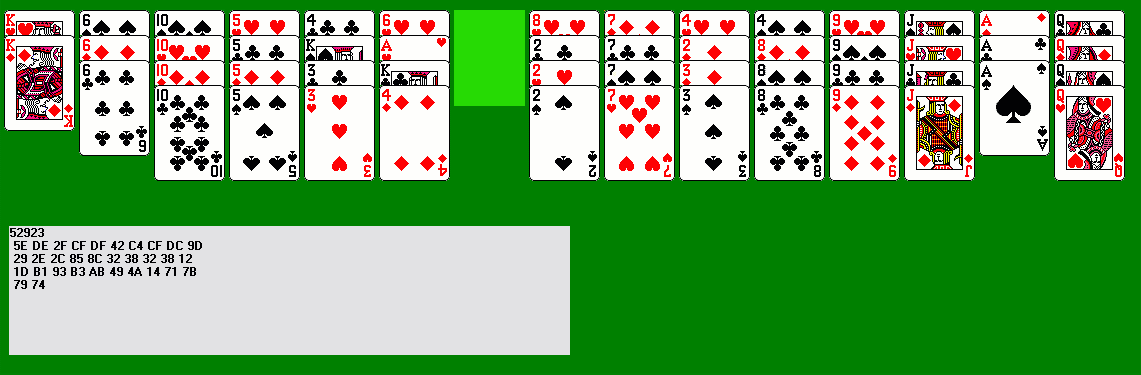
If we move all four threes (from columns 5 and A) into the empty column
7, we can clear column 6 (king of spades to column 1, four of diamonds
to column 5; finish three quartets with king of clubs, ace of hearts,
and six of hearts). The last three quartets are easy -- all four
twos to an empty column, then finish the eights and fours). Our
completed solution is:
52923
5E
DE 2F CF DF 42 C4 CF DC 9D
29
2E 2C 85 8C 32 38 32 38 12
1D
B1 93 B3 AB 49 4A 14 71 7B
79
74 57 A7 51 65 61 6E 62 86
A6
B8 A5 B5
Like many open solitaires, Beeswax has a very high win rate with
expert play (the standard game is over 99% by Mark Masten's analysis). I have been
able to win up to 98% of various blocks of 100 Solitaire Virtuoso deals given
enough attempts,
though I only win about 1 in 3 on the first try (without
undos). There is plenty
of skill involved: I
would rate this as one of the best open solitaires. The
game can also be played with varying numbers of ranks or suits:
Solitaire Virtuoso supports up to eight suits. Mark's
analysis covers many variations, including versions with only one extra
column (extremely unlikely to be winnable unless the number of suits is
reduced to two, or the number of ranks are reduced) or three (probably
almost always winnable even with five or six suits). The
larger version are extremely challenging: I have had only limited
success with 5x13 and 8x8 games.
There is also a puzzle version which does not use cards, but
colored balls or other objects (hoops, sand, water). It goes by many
various names, including Color Sort, Water Sort, etc. Herbert Kociemba
has several very detailed pages on this puzzle, including a
downloadable solver able to find optimal solutions to puzzles with
various parameters. He includes source code and description of the
algorithm. I do not even know if the puzzle version was derived from the card game or vice versa. I
decided to give the game a new name because it is something of an open
version of the second game we are looking at...
Beehive
is a storehouse game rarely
seen in books; my only sources are books on card games for children,
Joseph Leeming's Games and Fun With
Playing Cards
(1980 Dover abridgement of an 1949 original), Alfred Sheinwold's
101 Best Family Card Games
(Sterling, 1992), and Vernon Quinn's 50 Card Games for children (USPCC 1946,
where it appears as Honeybee). It is also rare as a
computer game: until recently, I had only seen one version, no longer
available, by
NZP Games (their website no longer exists, but my 2005 copy of the game
still runs in Windows 11!). 10 cards are initially dealt to a
storehouse (only the last card is face up; others are turned face up as
they are uncovered). Six more cards are dealt, one each to six
piles, to
start the tableau; the remaining 36 cards form a stock. The stock
is dealt, three at a time as in Demon or Klondike, to a
wastepile
(NZP and Leeming both specify that the stock be dealt with only one
card at a time visible, but I find games using the Demon deal much more
strategic if you spread each group of three, as you will see in the sample deal). If the top of the
waste matches any of the tableau columns in rank, it may be moved
there,
uncovering another waste card. When the stock is exhausted
(possibly after dealing one or two leftover cards as a group), the
waste can be turned over (without shuffling) and redealt, as many times
as necessary. When the fourth card of the same rank is moved to a
tableau column, the quartet of four cards are discarded, and the empty
column can be filled at any time with a card from the storehouse or
waste. Leeming specifies that an empty column must be immediately
filled from the storehouse, or from the top of the waste after the
storehouse is empty. But the game is also much more strategic if a
column may be left empty (NZP and Solitaire Virtuoso both allow
this). The object is to form and discard all
13 quartets of the same rank. NZP uses a
storehouse of 16 cards, but the game is probably too hard that
way. There is now a good version in BVS Solitaire,
with the same 10-card storehouse specified in
Leeming. Solitaire Virtuoso uses a 13-card storehouse
as a default; this can be changed to any value between 7 and
16. Beehive is a good game for practicing strategic
manipulation of the
stock, which may help in other games (such as Demon or the
three-at-a-time version of Klondike: Robert Abbott's site
has a discussion of how to use this strategy in playing Klondike).
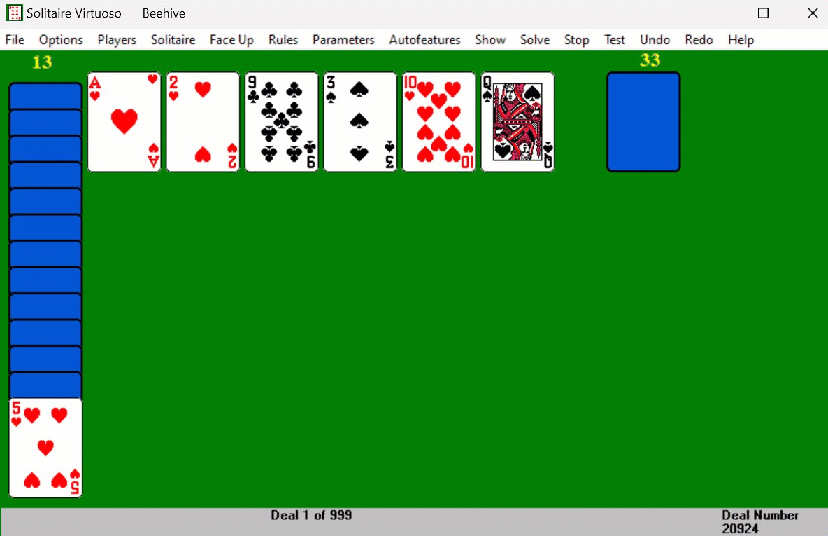
Above is a sample deal which we will play through, to illustrate some
of the tactics in Beehive. The initial deal of 20924 is
shown above, with a storehouse of 13 cards showing the five of hearts,
and six different ranks in the tableau piles: deals which provide no
initial spaces are much more difficult to win, but this one works
out. Run through the stock once, noting which available cards in
each turn of three can be matched to a tableau pile. You should also note how many of stock cards match the rank of the
current storehouse card: in this case all of the other fives are in the
stock. In this
case, the sequence of available cards in the stock is 8,4,A,8,7,5,9,2,9,T,4;
the matchable cards are boldfaced (we will refer to these cards as
earmarked). Generally we want to play these in reverse order:
ten, nine, two (a pair of twos is available, which is underlined),
nine, and ace. We have also noted that one of the top
cards is a five, the available storehouse card; this is also a
pair. The last five is also in the stock, but not available
yet. Recycle the stock by clicking on the empty space under the
zero which
shows the number of cards left. Now turn through the stock until
the ten of clubs appears in the next-to-last turn of three, and play
both the ten of clubs and the queen of hearts which is available
next. Recycle the stock and turn again until the second
nine (of hearts) appears, and play it. The next turn of three
shows the ace of diamonds; we are past the cards we earmarked on the
first pass, so play the ace now. That allows the two of spades to
be played also. Nothing else can be played on this pass,
but when we recycle we will eventually reach a pair of twos which can
be played, completing the twos pile, which is discarded
automatically. We can then play the nine of spades, which
reveals the nine of diamonds and completes the nine pile
also. This reveals the three of clubs, which can also be
played. We are in good shape, with two empty spaces, two quartets
complete, and an ace still earmarked in the third turn of three.
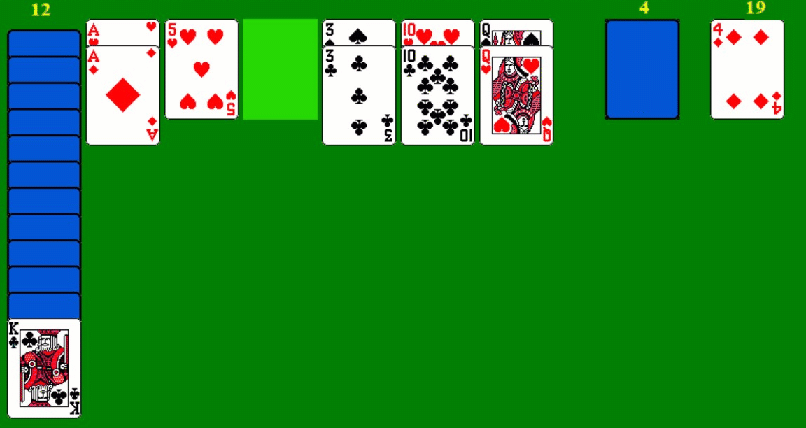
There are three fives in the stock, so we will play the five of hearts
from the storehouse to one of our open spaces, and work to release the
other fives (second diagram above). This should be easy, as two of them are on top
of a turn of three, and we have an empty space to help release the
last. In fact, when we turn the next three cards, the five
of clubs appears; we know that the other two fives are
available, so we play the five of clubs. We know that we will be able to finish the five pile, so we play the
two kings now available to the empty space, along with the king
of clubs now available in the storehouse. We
turn to the end of the stock, noting that the last two cards are both
fours. We recycle the stock
again; we have an ace and the two fives earmarked. The
first turn of three shows a king second; after we complete the five
pile we can free that king by playing the eight into the space (this is
a common tactic, freeing the second card in a turn of three to complete
a quartet, and regaining the space). Turn the stock until
you reach the two fives, and complete the five pile, followed by the
queen of clubs. Recycle the stock and play the eight of
diamonds and king of spades as we just mentioned, then the ten of
spades which is revealed (playing all three cards from a turn will not
disrupt the pattern of future turns). The next three cards are
not playable, but there is a four on top, and the last two cards are
fours, so we can be sure of completing a quartet of fours if the other
four is in the stock also. The
next three cards (ace of clubs, eight of spades, and queen of diamonds)
can all be played, completing the queen pile, and the three after that
shows the eight of clubs which can also be played. At
this point we have two spaces, and ten cards left in the
stock. It turns out that playing from the storehouse now
will win easily, but we cannot see that, so instead we will start a
pile of fours and extract the last three at the same time.
Recycle the stock and play the four of spades from the first turn,and
the last two fours from the end of the stock. Recycle again and
play the three of diamonds. Everything left in the stock is
sixes and sevens, so we must play the jack of hearts from the
storehouse, hoping to reveal one of the five cards we need to finish a
pile. It turns out that there are two more jacks, followed
by a ten to finish the tens pile. The seven of hearts is
now showing in the storehouse, with six cards under it, five of which
would finish a pile. Unless the last six is directly below the
seven in the storehouse, we will win easily, but what if it is the
six? The last six cards in the stock in order are
6,6,7,7,6,7. It turns out we can play all four sevens
anyway: play the seven of diamonds from the first turn of three (the
second seven will become the top card of the first turn of three when
we recycle), turn the last three and play the seven of clubs, recycle
the stock and turn three to reveal the seven of spades, and play
it. Now the game is impossible to lose, as playing the seven of
hearts from the storehouse completes seven quartets, guaranteeing that
every card left can be played to one of the six available tableau
piles. (Anticlimactically, the next card in the storehouse is the
three of hearts, so our clever maneuver didn't turn out to be
necessary, but it might come in handy at some time. In fact the
fourth six was the last card in the storehouse).
Jan Wolter, for his online Polymorphic Solitaire package,
devised a new interface for unlimited stock deals which he calls
Gallery Mode; the whole stock is simply spread out in order, and allows
any card to be selected in any order when the stock is dealt one a a
time (as in the standard version of Klondike). When the stock is
dealt three at a time, Gallery Mode shows playable cards by jogging
them upward. This works well for Beehive, eliminating the need to cycle repeatedly through the stock, and making it less of a memory game.
{Sequence of deal 20924: 6D AS JC 4H 8H 3H 7H TD JD JS JH KC 5H AH 2H
9C 3S TH QS TS KS 8D 6C 6H 4C QD 8S AC 3D 7D 8C 7S 6S 7C QC 5S 5D 4D 3C
9D 9S 2C 2D KD KH 9H 5C QH TC 2S AD 4S}
Copyright ©2024 by Michael Keller.
All rights reserved. This file was revised on May 31, 2024.