Fourteen Out -- a traditional open solitaire
Among the hundreds of different forms of card solitaire, many of the most skillful games
are found among the open solitaires, where all of the cards are dealt face up at the start
of the game, with no redeals. One of these is Fourteen Out, which dates
back at least sixty years or so. There is fair opportunity for skillful play, and an
expert player can probably win between 90 and 95 percent of the time. A single deck of
cards is dealt into twelve columns, one row at a time, with the last four cards being
dealt to the four leftmost columns, which will contain five cards each, while the other
eight columns each contain four. Any two uncovered cards (which must of course be in
different columns) which add to 14 (jack, queen, king counting as 11, 12, and 13
respectively) may be removed at the same time (e.g. an uncovered king and an uncovered
ace, Q and 2, J and 3, etc.). The object is to remove all 52 cards. Removing a card makes
the card immediately below it available for subsequent plays, but a card may not
be removed along with a card it is covering (e.g. king of clubs and ace of hearts). Can
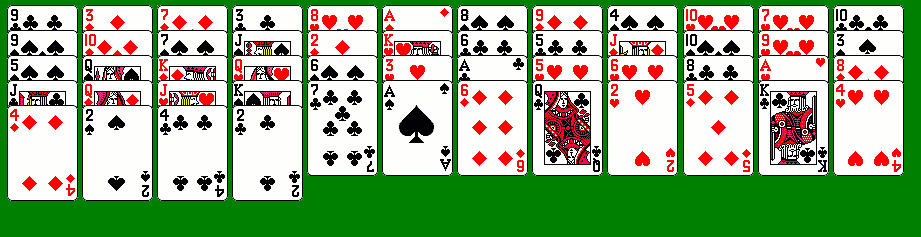
you discard all 52 cards in the deal below? The solution is here.
I have been experimenting with a computer solver for Fourteen Out. The solver is very simple at present, using a brute force search, but it is able to solve almost two-thirds of the deals it is presented with, usually in a second or two. On one or two percent of the hands (generally those which block after a few plays) the solver is able to determine that there is no solution. By attempting to solve the rest of the deals by hand (some can be seen to be impossible, for example if there are three sevens in the same column), I have increased the success rate to 358 out of 400 deals, with 15 clearly impossible and 27 not determined yet. Below is an example of a deal, number 1344, which was found impossible by detailed examination of the crossblocks:
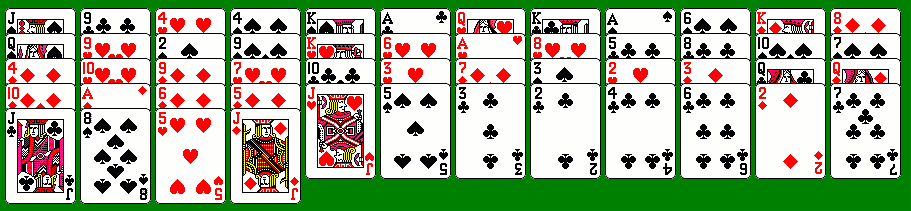
The red fives in columns 3 and 4 block two of the nines; the other two nines in column 2 must pair up with the red fives. In order to release them, we need a six, king, and four. The six of clubs in column 10 is available, but the other sixes are blocked by fives or eights. The four of clubs in column 9 is also available, but we need a king. All four kings are blocked by tens or eights; we can use the four of clubs (or better, the four of diamonds in column 1 after removing the jack of clubs and pairing the ten of diamonds with the four of clubs) to release the ten of clubs in column 5, and the king of hearts to release the ace of diamonds in column 2, but there are no fours available to release the ten of hearts. We can discard at most 24 cards.
This article is copyright © 2008, 2009 by Michael Keller. All rights reserved.
Portions of this article previously appeared on the Games Cafe (www.gamescafe.com) in February of 2000; that site is no longer in operation.